What do AI models say about your brand?
Find out whether ChatGPT, Gemini and four other AI platforms recommend your brand or your competitors, and why. We ask the models the questions your customers ask before they buy, many times over, and a scoring model rates every mention of your brand. A Vestigio specialist turns the results into an action plan for marketing and PR.
What do you get?
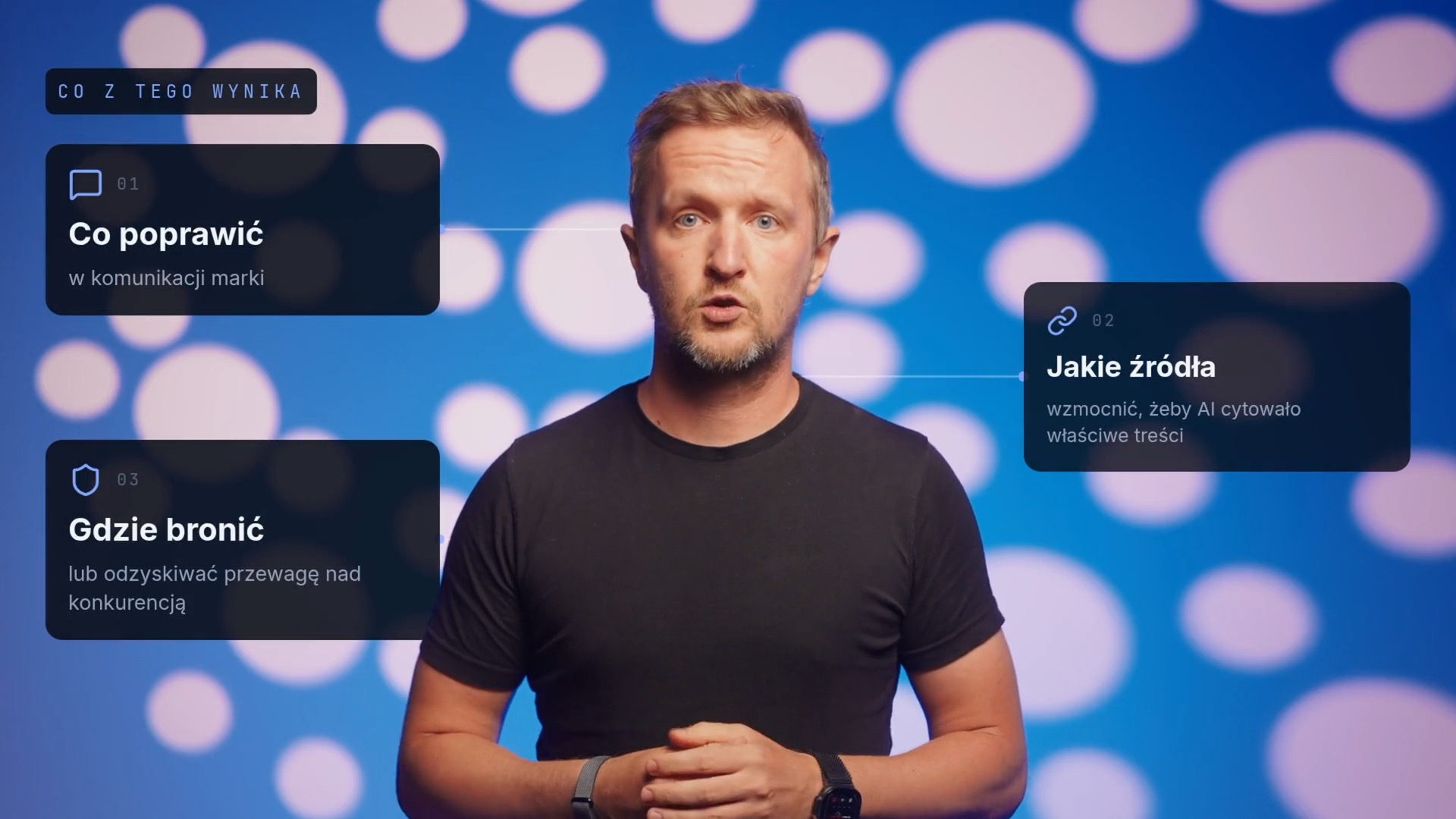
- Sentiment and presence in every purchase decision areaSee in which areas (for example price, quality, service) AI recommends your brand, and where it advises against it or leaves it out.
- A comparison with the competitors you nameKnow where you lose ground, and why.
- The sources AI models citeKnow where to focus PR and content work.
- A priority matrix and an action plan from a specialistKnow what to tackle first this quarter.
Contact
Check what AI says about your brand
Thank you for your message.
Vestigio has received your enquiry. The next step is a conversation about your objective.
k.czarnecki@vestigio.plCompanies we work with



















Which questions will the report answer?
Does AI mention my brand at all?
The report tells you whether models name your brand and for which customer questions they do it. A brand that is absent, a brand mentioned only when the question contains its name, and a brand mentioned but never recommended are three different situations, and each calls for different action.
Decision it supports: Where to start: building the brand's presence in the sources models cite, or working on how it is rated.
Does AI recommend me, or just mention me?
You see whether AI models recommend or advise against your brand in each of your customers' purchase decision areas, and how that compares with competitors. The report shows how positively or negatively you are rated, and how often the first choice is you, the competitors you named, or other brands.
Decision it supports: Which purchase decision areas need stronger communication.
Why does AI recommend competitors instead of me?
The analysis shows which themes recur in AI answers about specific purchase decision areas, separately for each brand studied. So you see not only your strengths and weaknesses, but also why the models rate you the way they do.
Decision it supports: Which arguments to add to your communication to answer competitors' advantages.
Where does AI look for information?
Only part of a model's answer is based on content from your own site. Models mostly draw on outside sources: forums, social media, topical portals and many less obvious places. The report lists the specific domains and URLs the models cited when answering questions about your brand or your competitors, together with the sentiment of the answers that cited them.
Decision it supports: Which portals, forums and review sites to target with Digital PR.
How does this change over time?
The first analysis is your baseline, and each one after it shows whether your work actually changed how AI models see the brand. You see how your score and your competitors' scores move between analyses, and in comparison mode exactly what changed: the overall score, purchase decision areas, single prompts and cited sources.
Decision it supports: Whether to continue a PR or content campaign, or change its direction.
What should we act on first?
The report ranks areas by how often models talk about them at all and how far behind competitors you are in each. The priority matrix shows what to fix first and where it is enough to defend your lead. The report closes with a summary and an action plan.
Decision it supports: Which areas get marketing budget next quarter, and which you only watch.
What do you get from the analysis?
Every analysis ends with the same set of materials: online, downloadable and ready to pass on inside your company.
Interactive online report
Configurable PDF report
XLSX export with the full data set and quotes
24/7 access to every analysis you have run
Comparison mode between analyses
Executive summary and action plan, edited by a specialist
Client voices
What do clients value about working with Vestigio?
 5.0/5 · 11 reviews
Vestigio helped us increase organic visibility and improve the quality of traffic from Google through a well-planned and consistently executed SEO strategy. I appreciate their expert knowledge, data-driven approach and ability to translate strategy into specific, implementation-ready recommendations. The cooperation is structured, effective and has a real impact on business results.
Read the full testimonialShow less

Vestigio provided comprehensive support for the launch of the new endorfy.com website, taking care of key SEO aspects both during preparation and the migration itself. We appreciate their expert approach, specific recommendations and smooth cooperation with our team. Most importantly, Vestigio's work not only maintained our organic visibility after the site change, but also drove further growth in traffic and sales generated by the new website.
Read the full testimonialShow less
An accurate diagnosis combined with extensive technical SEO expertise resulted in the rapid preparation of recommendations containing fixes for our team to implement. Vestigio also showed an excellent approach to the client and understanding of our processes. Vestigio is definitely a good choice. I recommend working with them.
Read the full testimonialShow less

Working with Vestigio delivered the agreed results. Thanks to a comprehensive approach to optimizing content and site structure, we achieved high visibility in search results. The simplicity and effectiveness of the work allowed us to significantly increase organic traffic, which translated into greater interest in our educational offer. We are very happy with the results achieved in such a short time.
Read the full testimonialShow less

Vestigio stands out through an innovative approach to SEO, understanding and adapting the work to client needs, as well as comprehensive and timely delivery. Its deep technical SEO knowledge leads to improvements whose effect is rapid growth in site visibility. I definitely recommend working with Vestigio.
Read the full testimonialShow less

Vestigio is defined by expertise, ingenuity and insight in solving problems. Its proactive attitude and transparency in communication and reporting are second to none among SEO agencies.
Read the full testimonialShow less

Our cooperation with Vestigio was reliable and professional at every stage. The visible commitment to the work, openness to exchanging ideas and feedback with our team, and unconventional approach to optimizing the site and its structure translated into the achievement of our goals. A combination of deep technical SEO knowledge and attention to the latest trends delivered steady growth in site visibility, ending with third place in the 2025 SEO in e-commerce report among online stores in our sector. Vestigio also deserves recognition for the team's very fast response to current situations, which repeatedly proved crucial in resolving unexpected challenges. We are satisfied with our cooperation to date and confidently recommend Vestigio's services.
Read the full testimonialShow less

A professional approach to the client, followed by results. Our website recorded a significant increase in organic search visibility, and this is undoubtedly thanks to the Vestigio team.
Read the full testimonialShow less

Innovation, modern technology and an excellent understanding of trends certainly distinguish Vestigio in the highly competitive SEO agency market. The team demonstrates great professionalism in audits, technical implementation and content creation. I recommend Vestigio as an excellent partner supporting business growth.
Read the full testimonialShow less

Accurate diagnoses, enormous expertise, specific examples and hard analysis. The result is optimized advertising, maximized reach and excellent SEO performance. The work is carefully considered, with nothing left to chance. We are confident that Vestigio is the right partner, not merely a service provider.
Read the full testimonialShow less

I finally found a company that knows exactly what it is doing. An unconventional approach to business challenges and genuinely measurable results build trust in the work. Cooperating with Vestigio is a real pleasure.
Read the full testimonialShow less

I have worked with many SEO agencies, and Vestigio strongly distinguishes itself in the Polish market through quality, communication, effectiveness and expertise. The company is always helpful and has a group of excellent, experienced specialists who have built an agency grounded in knowledge, tools and vision.
Read the full testimonialShow less

I can confidently recommend Vestigio as a reliable, committed and timely partner. At every stage of the cooperation, the agency pays close attention to detail, conducts thorough analyses and provides clear recommendations that have a real impact on results. I appreciate its proactive approach, professionalism and ability to adapt the strategy to the project and sector.
Read the full testimonialShow less

What does this look like in practice?
See what the report looks like in a demonstration analysis, in English and in Polish.
- Enlarge screenshot ↗
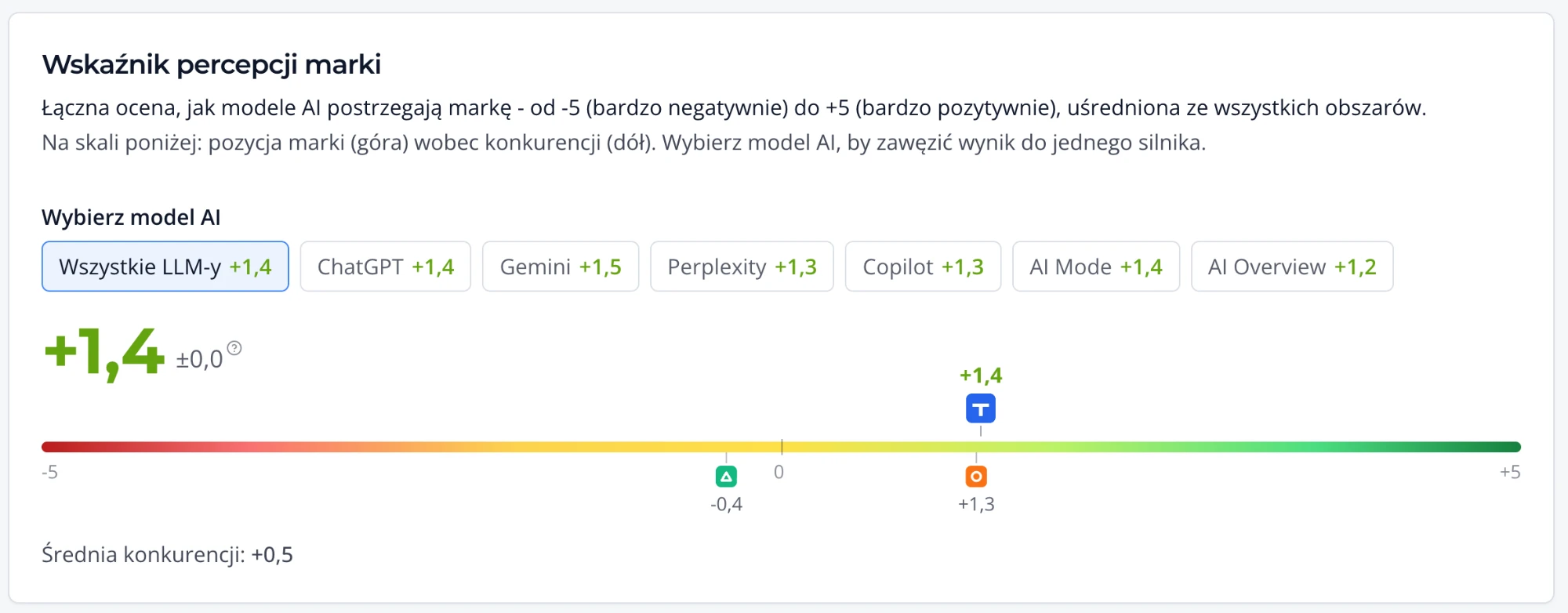
Brand perception score against competitors, split by AI platform
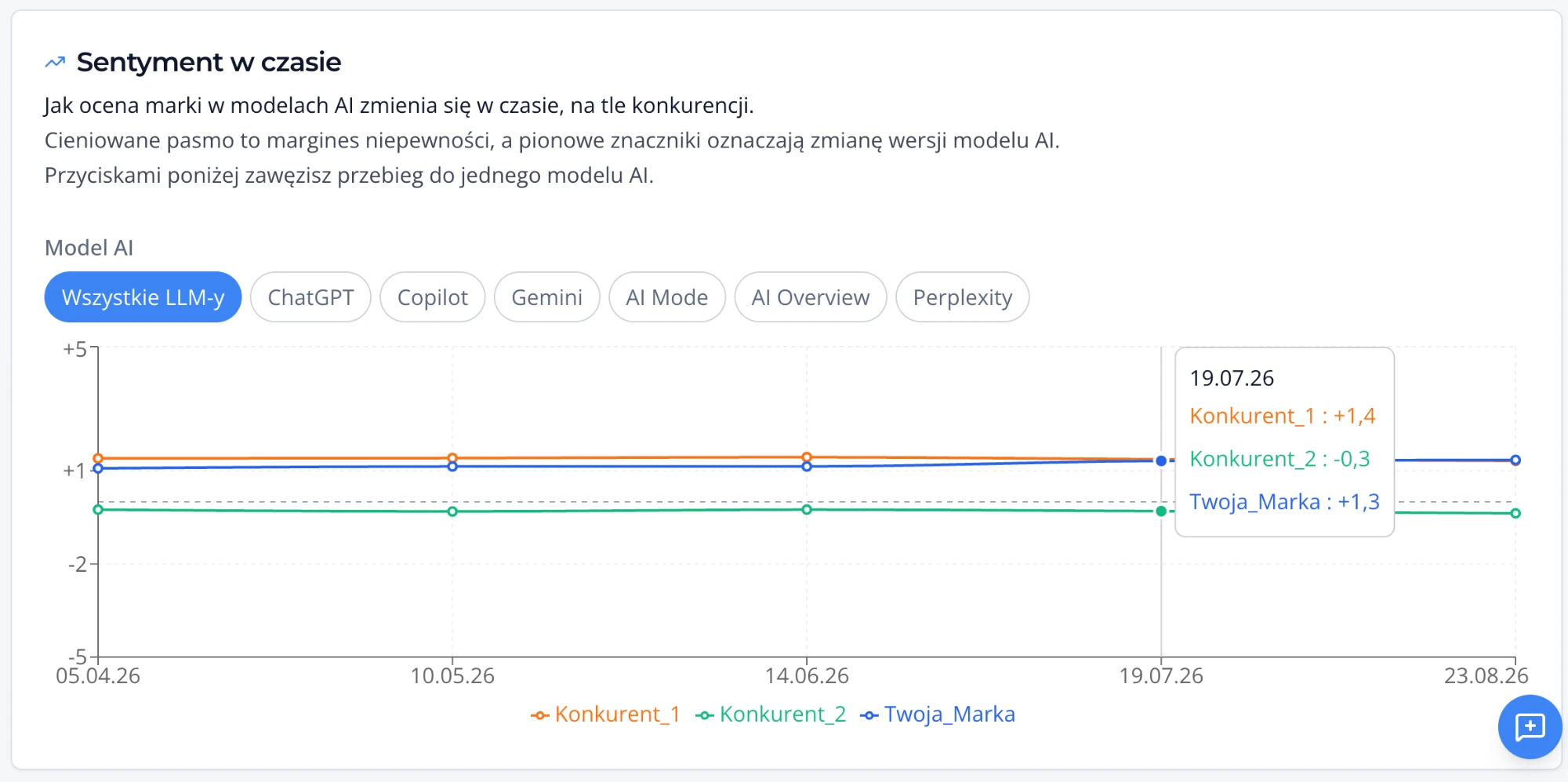 Enlarge screenshot ↗
Sentiment over time, with AI model version changes
 Enlarge screenshot ↗
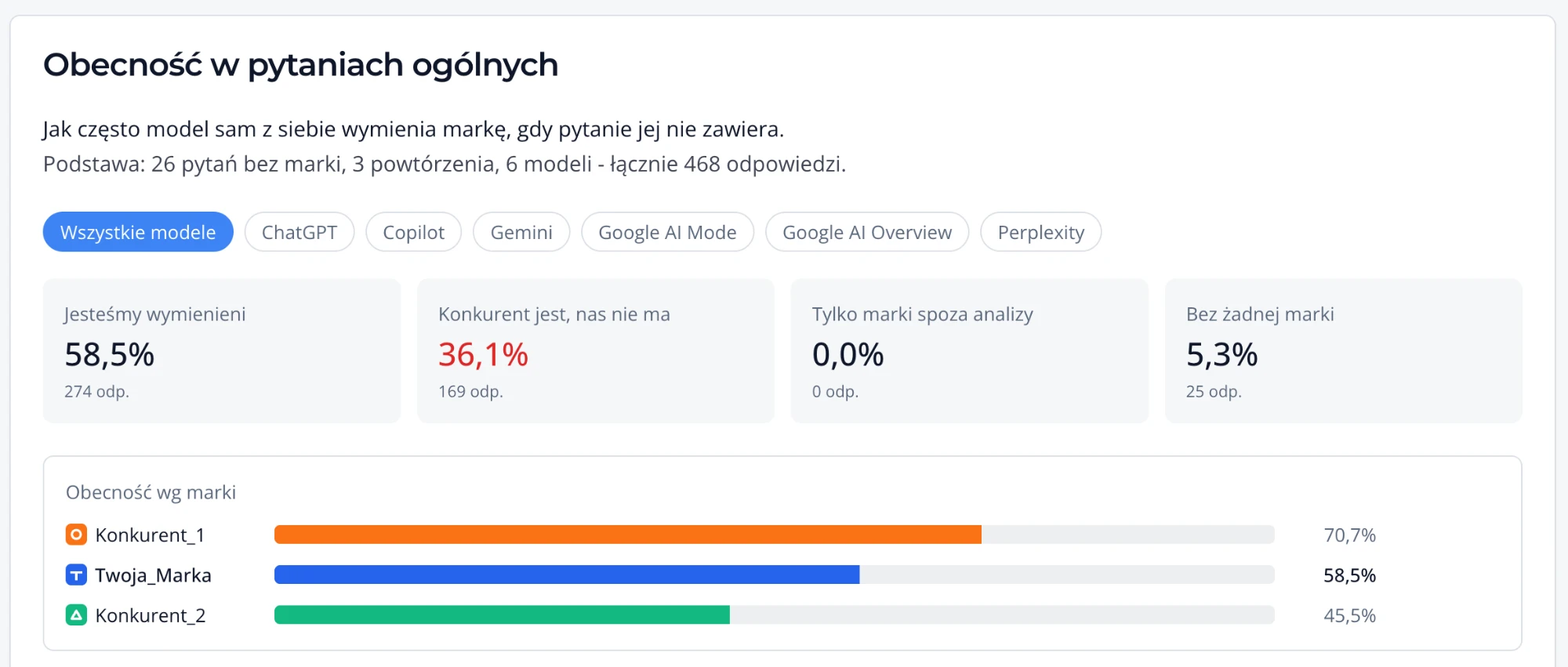
Presence in general questions, without the brand name in the prompt
 Enlarge screenshot ↗
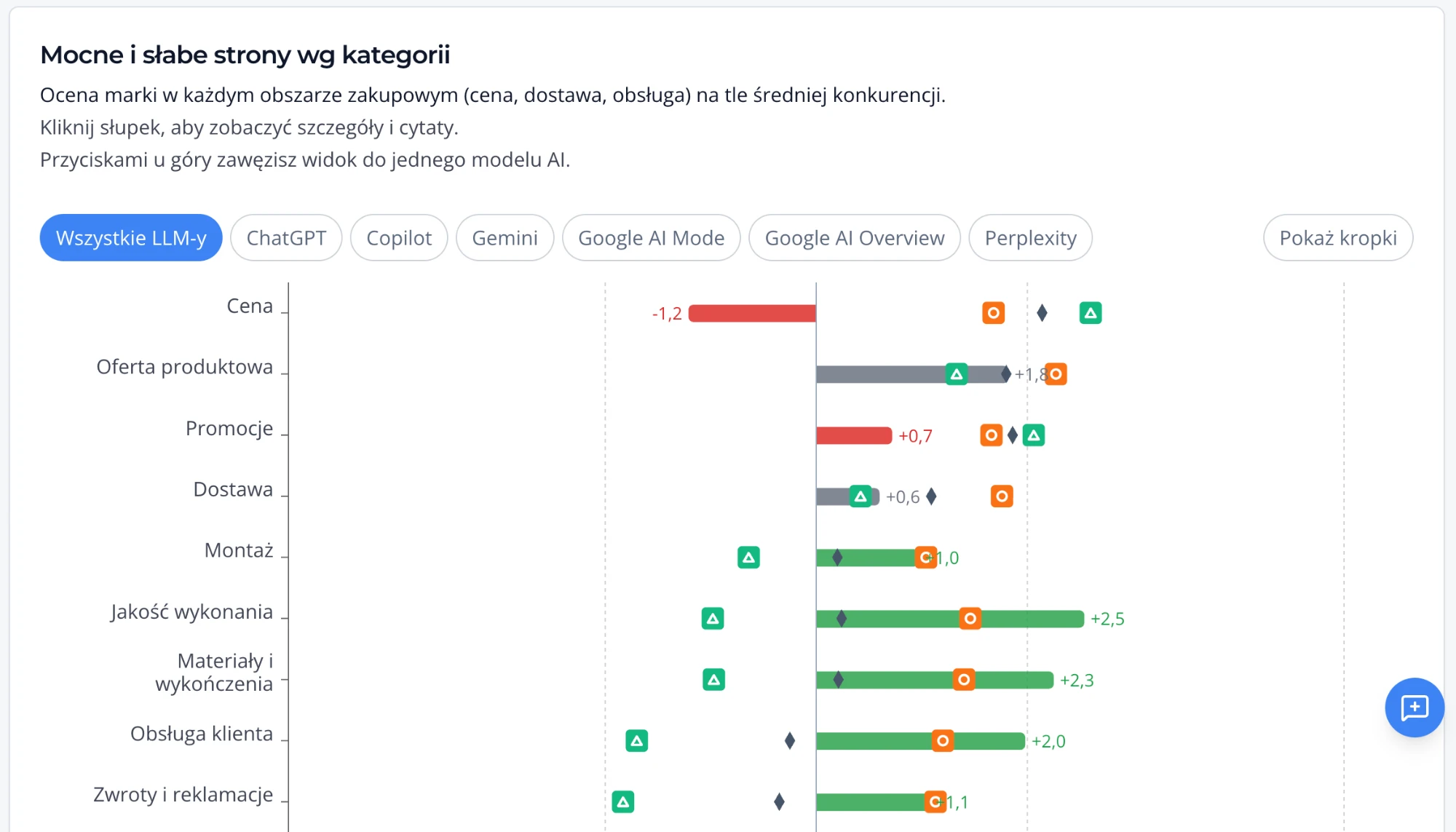
Strengths and weaknesses by category, against the competitor average
 Enlarge screenshot ↗
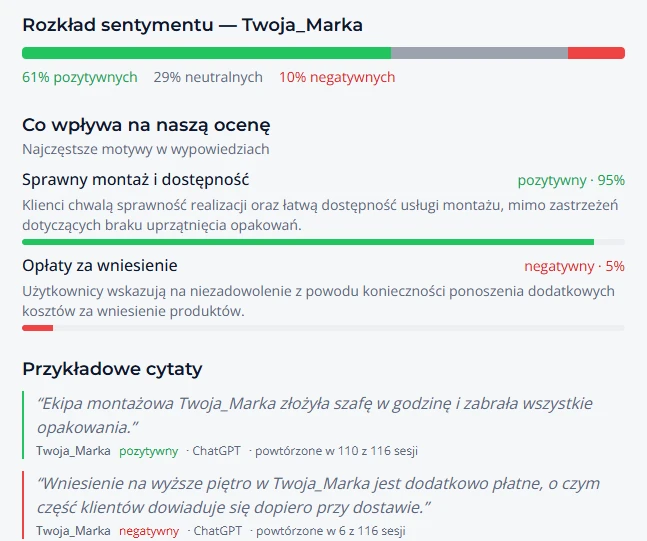
Sentiment split within a category and the themes behind it, with quotes, the AI model and the number of sessions each one recurred in
 Enlarge screenshot ↗
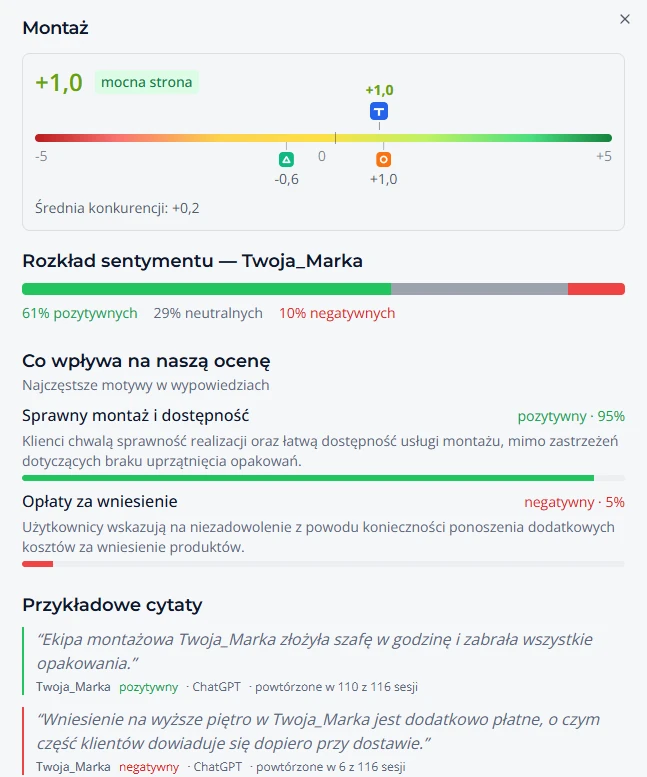
The full view after opening a category: the score on a -5 to +5 scale next to competitors and the competitor average
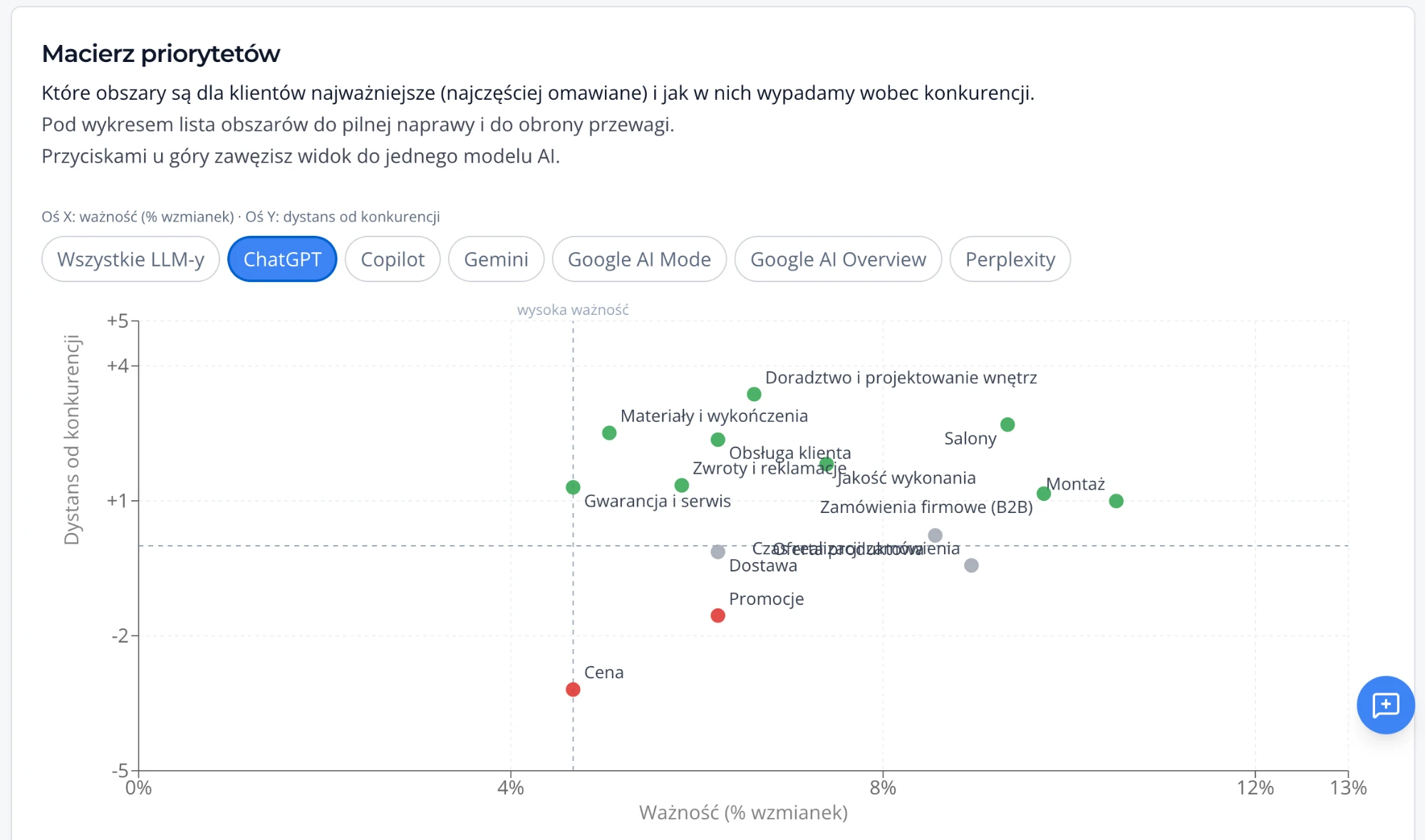 Enlarge screenshot ↗
Priority matrix: category importance against distance from competitors
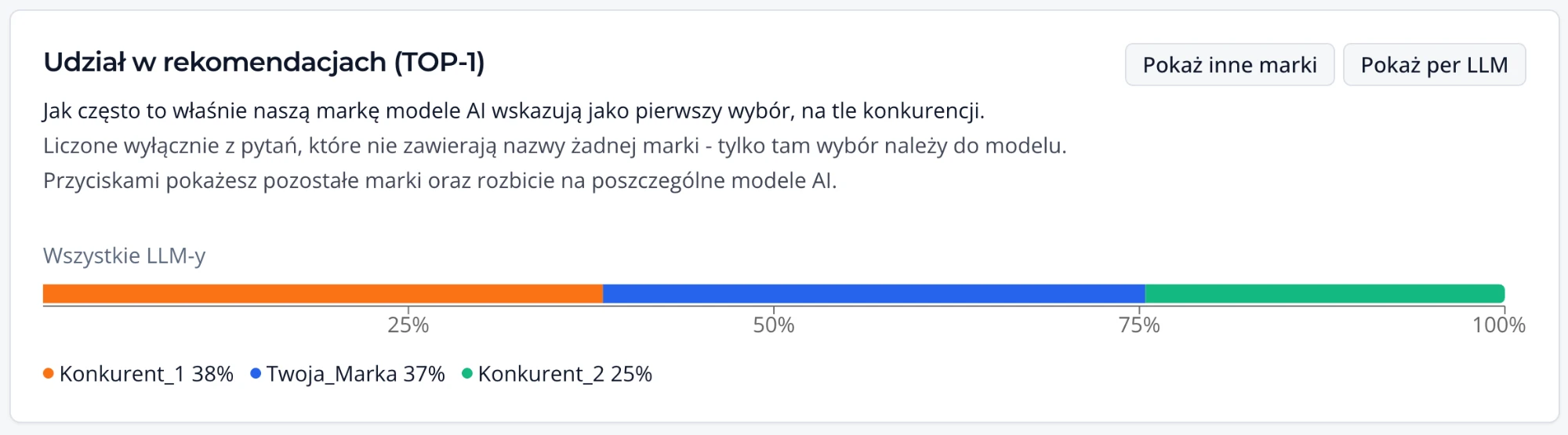 Enlarge screenshot ↗
Share of recommendations: how often the model picks the brand first
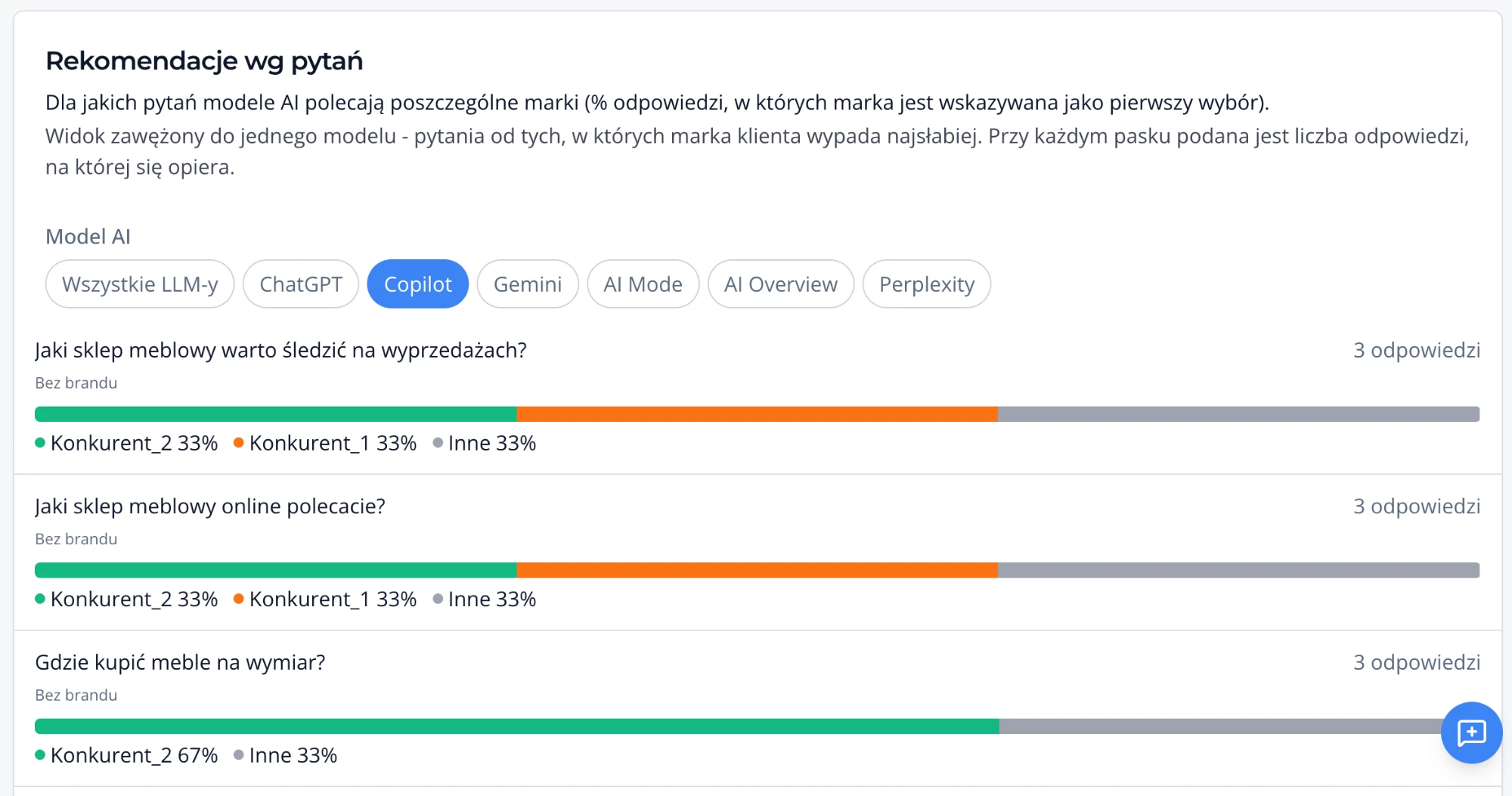 Enlarge screenshot ↗
Recommendations by question, with the answer count on each bar
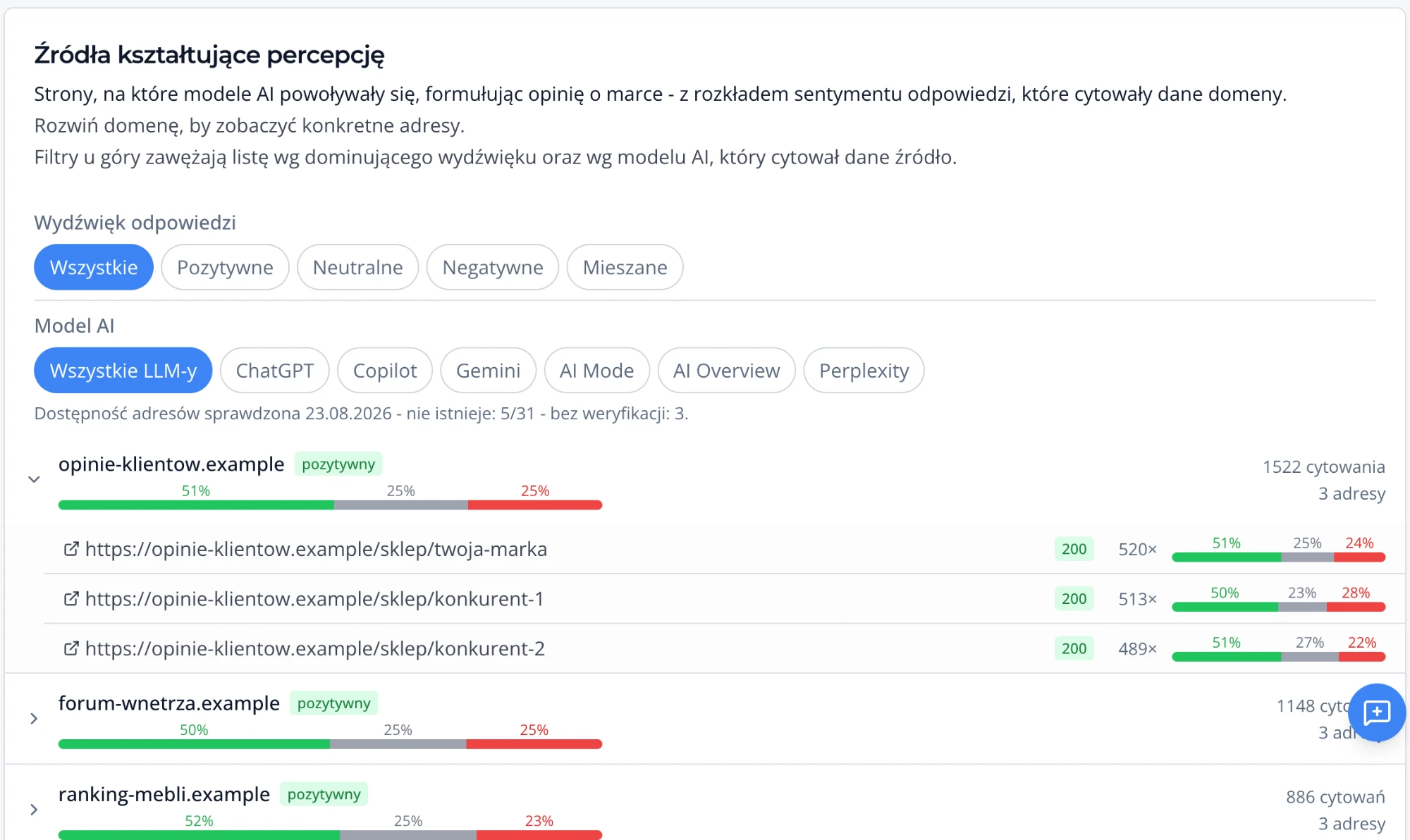 Enlarge screenshot ↗
Sources shaping perception, with the sentiment split of cited pages
How do marketing teams use the results?
Three examples from brand perception analyses we have run, described without client names. Each shows the question the analysis answered, the data from the report and the direction for action that follows from it. The next analysis on the same configuration shows the effect of that work.
AI sees the brand as expensive
- Question
- How do AI models talk about the price of my products?
- What the analysis showed
- In the analysis of a building materials manufacturer, 32% of mentions about price were negative. At the same time the models rated product quality and durability highly, and the argument that the higher price reflects quality appeared in 14.5% of AI statements about price.
- Recommendation
- Strengthen communication that explains what the customer pays for: product durability, warranty terms and the cost over the whole product life. Develop this message also in the sources AI cites in this industry, such as trade portals and contractor websites.
Rated well, but rarely mentioned
- Question
- Does AI mention my brand as often as my competitor?
- What the analysis showed
- A cosmetics brand was rated by AI models as well as its competitor, but appeared in 6% of mentions, against 46% for the competitor.
- Recommendation
- Extend Digital PR work to the domains AI cites most often in the industry studied.
A review site cited more often than the brand's own website
- Question
- Which sources does AI cite when it talks about my brand?
- What the analysis showed
- AI models cited an employee review site more often than the brand's own website.
- Recommendation
- Actively run the employer profile on that site and respond to employee ratings and questions in the areas the analysis identified as important for the brand's image in AI.
When will this analysis help you most?
- You check yourself what AI says about your brand and want to measure it, not guess
- You are starting GEO work, shaping how your brand appears in AI answers, and need a reference point
- You are losing to a specific competitor but do not know exactly where
- You are running a quarterly or annual review and want to add AI brand perception to it
- You are coming out of a reputation crisis and need a quick reference point
- You just finished a PR or content campaign and want to check whether it moved brand perception in AI
How does the analysis run from start to report?
We start with a workshop where we agree together what you want to learn about your brand and which competitors to compare it with. After the workshop we take over: we configure and run the analysis, then check the quality of the data. Our specialist turns the results into conclusions, priorities and an action plan, which you receive in the report. You can order the analysis once or repeat it to track how perception of your brand changes.
Part 1: Preparation
Step 1
Workshop
- What Vestigio OS does
- Suggests starter sets of purchase decision areas matched to the business profile, an online shop or a B2B manufacturer for example.
- What the expert decides on
- The specialist runs the workshop (30 to 60 minutes) and agrees with you the brands under study and their spelling variants, the competitors, the purchase decision areas and, optionally, your own prompts for the models. That is the main input we need from your side.
Step 2
Setup
- What Vestigio OS does
- Saves the analysis settings and freezes the configuration once it starts, so the result stays comparable over time.
- What the expert decides on
- The specialist turns the workshop decisions into the configuration: the brand list, the competitors, the areas and the question set.
Part 2: Measurement
Step 3
Collecting answers
- What Vestigio OS does
- Queries six AI platforms repeatedly, in clean sessions, with geolocation matching the chosen market.
- What the expert decides on
- The specialist oversees the launch and makes sure the analysis runs correctly.
Step 4
Scoring and aggregation
- What Vestigio OS does
- A judge model extracts brand mentions with an evidence quote and aggregates results into a -5 to +5 score.
- What the expert decides on
- Once the run is complete, the specialist checks sample quality and brand name variants to avoid matching errors.
Part 3: Report
Step 5
Report
- What Vestigio OS does
- Builds an interactive report with a dozen or so sections that give you a complete picture of how AI perceives your brand.
- What the expert decides on
- The specialist edits the executive summary and action plan, then shares the report with you online and as a PDF.
Why do we separate sentiment from presence?
“What is said about us” and “whether we are mentioned at all” are two different problems. A brand can score well in a handful of mentions but still have low presence - models simply rarely bring it up when answering category questions. The reverse also happens: a brand mentioned often but scoring low in a specific purchase decision area.
Separating the two dimensions points to different fixes: building content footprint where presence is low, or working on narrative and sources where sentiment is low. The report shows both dimensions broken down by purchase decision area and against the competitors you name, with a list of sources shaping the models’ opinion.
How do we make a single measurement reliable?
We run each question by default 5 times on each of six platforms, in a session without login and without any history of earlier conversations, with geolocation matching your market. A separate judge model extracts brand mentions from every answer with an evidence quote, and scores them the same, consistent way every time. The result is a score on a -5 to +5 scale with an arithmetic mean and standard deviation.
We tested the quality of the judge model’s scores by hand: its scores were almost identical to human ratings.
What is inside the scope of this analysis, and what is not?
The analysis measures brand perception in AI models, not the actual state of the company. It does not measure personalized answers, and it does not query the model APIs, only their public chat interfaces.
The analysis does not fetch the content of cited sources, only checks their availability. The result can therefore reflect content from months or years ago, not the company’s current state. The model writing the summary cannot state facts beyond the supplied measurement data. A sample smaller than 25 mentions in an area is not presented as a finished conclusion, only as a signal for further observation.
How do you know if this analysis fits your brand?
The brand is recognised online
The bigger the brand, the more readily people comment on it and rate it online, and the more often it appears in detailed, complete answers from the models. That lets the report show not only whether the brand is visible in AI Search, but also how it is rated in each of your customers' purchase decision areas.
Comparable competitors exist
The score makes sense for brands that compete with you directly for customers. Pick competitors of a similar size, especially the ones you actually lose customers to. Otherwise you get a flattering report that is detached from reality.
You want a marketing view, not an SEO audit
The report describes how the brand is perceived: sentiment across purchase decision areas, presence, and standing against competitors. It is material for marketing, brand and communications, not a technical fix list. It ends with an action plan, so it works for anyone who shapes priorities: a manager, a director or above.
What do companies ask before ordering the analysis?
How is this different from just checking ChatGPT myself?
The difference is scale and evidence: one answer in one chat versus a report with a dozen or so sections, a specialist-written action plan, a competitor comparison, a trend over time, export and filterable data. On top of that comes the competitor benchmark and an evidence quote behind every score.
How large is the evidence base behind the report?
Large - for example, an example analysis sent 5190 queries to AI models. That is the scale of the evidence base behind one report, not the result for a specific client, which we do not publish without consent.
Where does the data come from - is this through the model APIs?
No. The data comes from public chat interfaces, queried automatically by Senuto Pulse the way a real user would, not through the model APIs.
Which AI platforms are checked?
ChatGPT, Gemini, Perplexity, Copilot, Google AI Mode and Google AI Overview. The report shows a combined score and a separate score per platform.
Does the score describe the actual state of the company?
No - the score describes how AI models perceive the brand based on content from the internet, often months or years old. It is brand perception in the models, not an audit of your company.
Which brands does this analysis make sense for?
The brand needs to be recognised online and to have comparable competitors. The number of competitors in an analysis is not capped, you name the ones you actually lose customers to. A monopolist or a brand unknown to the models will get a report with a large share of no data statuses.
What do I get at the end?
An interactive online report behind a public link, read-only and with no login, plus a configurable PDF report and an XLSX export with the full data set and quotes. A Vestigio specialist edits the executive summary and action plan before it is sent.
How much time do I need to invest at the start?
At the start we need a workshop that takes 30 to 60 minutes. In it we agree brands, competitors and purchase decision areas with you - that is the main input on your side.
Can I ask the models my own questions?
Yes. In the workshop you add your own questions to the set, for example where to buy your product at the lowest price. The report then shows which stores and sites the models point to and which sources they cite, and the XLSX export contains the full quotes of the answers. From that you can check whether AI sends customers to marketplace offers that break your pricing policy.
How often should the analysis be repeated?
We set the cadence by how intensively you work, not by the calendar. With intensive GEO work, monthly makes sense, because the content and sources the models draw on genuinely change between runs. With lighter activity, a less frequent measurement works as a reference point, for example after a campaign or a reputation crisis. The configuration stays the same, so successive results remain comparable.
How much does this cost?
The scope depends on the number of purchase decision areas, competitors and questions. We set the quote individually after a short conversation about your brand.
Contact
Let's talk about your brand
Leave your email and brand domain and we will get in touch to discuss the scope of the analysis.

Thank you for your message.
Vestigio has received your enquiry. The next step is a conversation about your objective.
k.czarnecki@vestigio.pl